

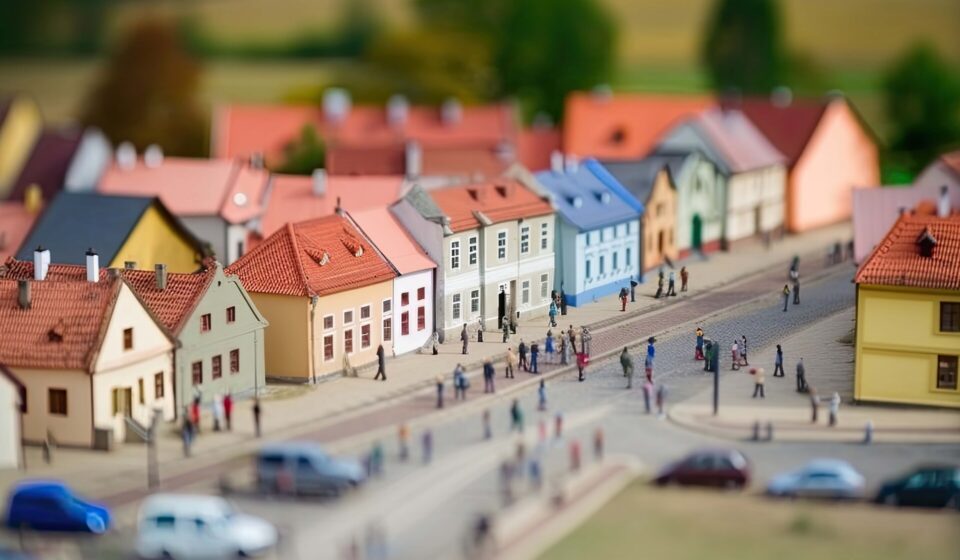

From elaborate model railway layouts to tiny handmade houses, miniature worlds have fascinated people for generations.
There is something unusual about seeing a familiar environment recreated at a fraction of its normal size. Everyday details become more noticeable, ordinary scenes appear almost magical, and entire landscapes can fit inside a single room.
Although miniature modelling is sometimes regarded as an old-fashioned hobby, it continues to attract enthusiasts of different ages and backgrounds.
The Appeal of Creating a Smaller World
Miniature modelling allows people to recreate places, objects and scenes that would be impossible to construct at full size.
A model railway enthusiast might build a detailed representation of a countryside station, complete with platforms, buildings and surrounding fields.
Someone interested in architecture might create a miniature street, while another hobbyist could spend months building an intricate doll’s house.
The attraction is partly creative and partly technical.
Enthusiasts must consider proportions, materials, construction methods and the appearance of the finished scene.
There is also a sense of control that comes from designing an environment where every detail can be carefully planned.
Model Railways and Their Lasting Popularity
Model railways are among the best-known forms of miniature modelling.
For many enthusiasts, the hobby involves much more than watching trains travel around a track.
Layouts can include realistic buildings, roads, bridges, stations and landscapes.
Some recreate particular periods of railway history, requiring careful research into architecture, vehicles and everyday life.
Others are entirely fictional, allowing the builder to invent towns, industries and transport networks.
Modern model railways can incorporate digital control systems, realistic sound effects and sophisticated lighting.
Despite these technological developments, traditional skills such as painting, woodworking and scenery construction remain central to the hobby.
Doll’s Houses and Miniature Interiors
Doll’s houses have a long history, with some early examples created as elaborate display objects rather than children’s toys.
Today, miniature interiors appeal to collectors, artists and craftspeople.
Enthusiasts may create tiny furniture, working lights, patterned wallpaper and decorative objects.
Some designs reproduce historical interiors, while others explore modern architecture and contemporary styles.
The level of detail can be remarkable.
A miniature kitchen might contain individually crafted utensils, food containers and appliances, while a living room could include books, cushions and framed pictures.
The challenge of reproducing familiar objects at a small scale is part of what makes the activity rewarding.
The Importance of Scale
Scale is one of the most important concepts in miniature modelling.
A model built to a particular scale maintains a consistent relationship between its dimensions and those of the real object.
This allows different components to fit together convincingly.
However, accurately reducing an object is not always enough to make it look realistic.
Certain details may need to be exaggerated slightly so they remain visible, while materials must be chosen carefully to avoid appearing oversized.
Lighting and photography can also influence how convincing a miniature scene appears.
With the right camera angle, a well-constructed model can sometimes be mistaken for a photograph of a full-sized location.
New Technology Meets Traditional Craftsmanship
Technology has introduced new possibilities for miniature creators.
Three-dimensional printing allows enthusiasts to produce components that would be difficult to make by hand.
Computer design software can help with planning buildings, furniture and mechanical parts.
Laser cutting has also made it easier to create precise shapes from wood, card and other materials.
However, these tools have not eliminated traditional craftsmanship.
Painting, weathering, assembling and arranging the finished scene still require patience and artistic judgement.
Many hobbyists combine digital techniques with handmade elements, using whichever approach produces the best result.
Miniatures as a Form of Relaxation
For some people, miniature modelling provides a welcome break from everyday routines.
The work often requires concentration on small, manageable tasks.
Painting a tiny window frame or arranging a miniature garden encourages attention to detail and can provide a satisfying sense of progress.
Projects may take weeks, months or even years to complete.
Rather than rushing towards the finished result, many enthusiasts enjoy the process of gradually developing their creations.
The hobby can also be social.
Clubs, exhibitions and online communities allow modellers to exchange ideas, share techniques and display completed projects.
A Different Way of Seeing the World
Perhaps the most interesting aspect of miniature modelling is the way it encourages people to notice their surroundings.
Someone building a miniature street may begin paying closer attention to brickwork, shopfronts, road markings and street furniture.
A modeller recreating a countryside scene might study the shapes of trees, the colours of fields and the way buildings sit within the landscape.
Details that normally go unnoticed become essential parts of the creative process.
This heightened observation can make everyday environments more interesting.
Small Creations, Endless Possibilities
Miniature worlds demonstrate how imagination and craftsmanship can transform ordinary materials into something remarkable.
Whether the project is a simple model building or an elaborate landscape, each creation reflects the interests and decisions of the person making it.
The finished result may occupy only a small space, but the amount of thought, skill and creativity involved can be enormous.
In a world increasingly dominated by digital experiences, the appeal of constructing something tangible, detailed and entirely personal remains as strong as ever.